DFW's Largest Custom Sign Company |
||||
|
Call Now! We're waiting!
Our Team of Experts are standing by to Answer Your Questions: (877) SINCE79 toll-free (214) 339-2227 Dallas (817) 861-1234 Fort Worth/Arlington (972) 850-3300 Other DFW Areas (254) 582-7446 Hillsboro/Waco Areas (903) 561-5959 Athens/Oklahoma (940) 365-3433 Denton/North Texas Email our Sales Team:
|
||||
Glossary of Common Sign TermsClick our "Message Center" tab under "Sign Types" for Electronic Message Center Glossary of Terms.Acrylic: A type of translucent thermoplastic. Very rigid, and long lasting, but not highly break resistant. Advertising Media: The means by which an advertising message is carried to potential customers; including Internet, magazine, newspaper, radio, signs and television. Aesthetics: A term dealing with form, design, and/or quality of construction of a particular sign, building, site or structure, that presents a judgmental statement concerning the level of beauty or artistic value. Amortization: In accounting terms, this refers to the method in which an intangible asset is depreciated over a specified period of time. In terms relevant to signs and urban planning, it conveys the "grace period" beginning on the date a sign owner is notified that removal of a previously conforming sign has been ordered, and ending on the date removal is required. This process makes a structure, which was legally erected with all permits, legally non-conforming for period of time. After an amortization period, the sign becomes illegal and non-conforming. Amortization has often been found to be a form of regulatory taking. The legality of amortization depends on state law and numerous other conditions, and is frequently unenforceable. Animated Sign: A sign depicting action, motion, light or color changes through electrical or mechanical means. Although technologically similar to flashing signs, the animated sign emphasizes graphics and artistic display. Annual Average Daily Traffic (Annual ADT): Measurement representing the total number of vehicles passing a given location each day. These counts can usually be obtained from your State Highway Department. Awning Sign: A building mounted sign that provides additional functionality as shelter. Back-lighted Letter: An illuminated reverse channel letter (open or translucent back) so light from the letter is directed against the surface behind the letter producing a halo lighting effect around the letter. Also referred to as Silhouette lighted or halo lighted. Back Sprayed: To paint on the inside of a piece of clear plastic. Ballast: An electrical device required to operate fluorescent lamps. Banner: A sign composed of lightweight material. Promotional banners include those used to announce open houses and grand openings, make special announcements, or communicate events. Ornamental banners use images or colors of a decorative nature. Bench Sign: A sign located on the seat or back of a bench or seat placed on or adjacent to a public right-of-way. A type of street furniture. Brand Equity (Branding): The intangible, but real, value of words, graphics or symbols that are associated with the products or services offered by a business. Developing branding of a site includes the presentation of signs and architecture to create a unique awareness and memory by the potential customer of the products or services offered at that site. Brand equity for a particular business is similar to the goodwill of an enterprise. Building Code: State and/or local regulations governing public health, welfare and safety of construction and maintenance. Building Fascia: That portion of any elevation of a building extending vertically from the grade to the top parapet wall or eaves, and horizontally across the entire width of the building elevation, including slanted wall surfaces sometimes referred to as a mansard. Building Mounted Sign: A sign that is applied or attached to a building. Cabinet Sign: A sign structure consisting of the frame and face(s), not including the internal components, embellishments or support structure. Canopy: See marquee. Canopy Sign: A building-mounted sign functioning as a marquee. Also a sign mounted on a marquee or canopy. Changeable Copy Panel: A section of a sign that functions like a changeable copy sign. Changeable Copy Sign: A variable message sign composed of individual letters panel-mounted in or on a track system. Channel-can Signs: Fabricated or formed three-dimensional box sign, matching a channel letter in size, that may accommodate a light source. Digital graphics or vinyl lettering decorate the face. Channel Letter: Fabricated or formed three-dimensional letter that may accommodate a light source. Coated Tubing: Clear glass tubing, coated on the interior surface with phosphorus powder. Coated tubing produces a variety of different light colors, dependent upon the specific mixture of phosphorus powders utilized. Cold Cathode: Neon which uses an electrode with a large metal mass to emit electrons. Neon tubing is large. Also a generic term employed to specify custom interior lighting produced through the use of larger diameter cold cathode tubing. Colored Tubing: Transparent glass tubing manufactured with color pigments, typically color examples include ruby red, canary yellow, green, and midnight blue. Conforming Sign: A sign that is legally installed in accordance with federal, state, and local laws and ordinances. Conspicuity: The characteristics of the sign that enable an observer to differentiate the sign from its surrounding environment. Content Neutral: Time, Place and Manner Regulations: Consistently applicable non-discriminatory sign regulations that specify, without reference to the content of the message, when, how and where a sign can be displayed, with physical standards, such as but not limited to height, size and location, that allow the sign to be readable. Contrast: The difference or degree of difference between things having similar or comparable natures, such as light and dark areas, colors, or typefaces. Copy: The words or message displayed on a sign. Copy Area: Areas that enclose the actual copy on a sign. Corrugated Background: A background that raises and lowers on regular intervals. Normally used with changeable copy track, the lowered area allows rain to wash dirt away from the tracks. Cost Approach (Valuation): An approach to estimating the value of real property whereby the appraiser determines the production cost of the property, minus any accrued depreciation. This approach does not merely include the hard costs of construction, but includes all soft costs such as interest, permits, and fees. In sign appraisal this concept includes the cost of replacing the message delivered to viewers. Cost per Thousand (CPM): Refers to the cost for an advertiser to send a message to 1000 receivers. The measure is calculated by dividing the amount of money spent for a given advertisement by the number of people exposed to it. (Based on this measure, signs are usually considered to be the least expensive form of advertising.) Coverage: A marketing term that refers to the percentage of the total market population reached by an advertising message displayed in a given medium; measured at least once a month. Customer Acquisition Costs: Basic value calculation used to measure the cost versus return from the presence of signs; the cost of acquiring a customer. Custom Sign: A sign designed, manufactured and installed to meet the requirements of a specific location. Daily Effective Circulation (DEC): The average number of daily potential exposures to a display or group of signs determined by counting only those vehicles traveling toward the face of the sign, and then multiplying that number by the average number of people per car during the hours the sign is visible. Pedestrian and mass transit circulations are not included. This is the basic measure in establishing cost per thousand exposures on signs. The basic traffic numbers can usually be obtained from your State Department of Transportation. Deck Cabinet: Similar in detail and use as a raceway except larger in cross section to provide a background area. Dimensional Letter: A specification description of a letter, logo or symbol, either cut out, cast, molded or fabricated in material such as metal or plastic to create a raised condition. Direct Bury: A pole that is buried in concrete below grade and extends up to the bottom of a sign. A pole setting on anchor bolts would not be direct buried. Directional Sign: Signs designed to provide direction to pedestrian and vehicular traffic. Directory Sign: A sign that identifies the names and locations of tenants in a multi-tenant building or in a development made up of a group of buildings. Double-Faced Sign: A sign with two parallel opposing (back-to-back) faces. Double-embossed: One layer, such as a plaque is embossed on top of the mold, then a second layer, such as letters, are embossed on top of the first layer. Double-masking: Some colors can not be painted over other colors, If you spayed yellow letters over a blue background you would get a green background. So the face is masked twice. The first color is sprayed and then masked again before the second color is spayed. Draw: Pan Depth; usually 1 1/2" deep Electric Sign: Any sign containing or using electrical wiring. Electric Sign Authority (ESA): The Electric Sign Authority (ESA) Supervises the design, marketing appeal, appearance, and longevity of signs. Electronic Message Center: A variable message sign that utilizes computer-generated messages or some other electronic means of changing copy. These signs include displays using incandescent lamps, LEDs, LCDs or a flipper matrix. Click our "Message Center" tab under "Sign Types" for Electronic Message Center glossary terms. Embossed: To raise above. Embossed letters are raised above the background. Exterior Illuminated Sign: A sign that is illuminated by a light source that is directed towards, and shines on the face of a sign. Also called direct illumination. Extrusion: A process in which material is heated to a molten form and pushed thru a die to make a shape Fair Market Approach: One of three appraisal approaches. The highest price at which a property could be sold given a reasonable exposure period in the market. The price is arrived at by a willing seller and willing buyer, neither being under duress to act. Fascia Sign: A building mounted sign. Flange: The outer flat area of a pan face that slides into the retainer. Flashing Sign: A sign with an intermittent or flashing light source. Generally, the sign's message is constantly repeated, and the sign is most often used as a primary attention-getting device. Government highway departments frequently use flashing signs to improve highway safety. Flat Cutout Letter: A dimensional letter cut from sheet or plate stock. Flat-face: The outer flat area of a pan face that slides into the retainer. Fluorescent Lamp or Tube: Electric-discharge lighting utilizing glass tubing manufactured to standard lengths. Font: A set of letters, numerals, and shapes, which conform to a specific set of design criteria. Formed: To take shape. See vacuum formed. Freestanding Sign: A sign that is not attached to a building. Frequency: The average number of times an individual has the opportunity to see an advertising message during a defined period of time. Typically measured over a four-week period. Front Lighted Letter: An illuminated channel letter with translucent face. Full Service Sign Companies: Sign companies that complete the entire signs project, including surveying, designing, engineering, permitting, manufacturing, installing, and maintaining signs. Ground Sign: A freestanding sign with no visible support structure. Gussets: A Reinforcing plate used in a sign. A plate welded to a pole may have gussets welded to both to insure that the plate can't break away from the pole. H Channel Letter: A dimensional letter with baffles at the center of the cross-sectional shape for support of neon tubing and mounting of transformers. Hanging-bar: A piece of plastic or metal attached to the flange of a sign face in order to keep it from coming out of the retainer. Normally used on the top center. Most extruded aluminium cabinets are designed to allow a hanger bar on the face. High-Rise Sign: A tall freestanding sign. Impulse Buying: An unplanned or shifted purchase. Incandescent Bulb: A lamp that produces light through the application of electrical energy to a wire filament, which glows as it is heated. Interior Signs: Signs that are located inside a building or other facility. Internally Illuminated Sign: A sign that is illuminated by a light source that is contained inside the sign. ISA: International Sign Association. Just Compensation: The full monetary value to be paid for property taken by the government in accordance with the Fifth Amendment of the U.S. Constitution. Just compensation is generally determined by obtaining an appraisal. Kerning: Adjusting the space between individual letters. (Also see Tracking.) Leading: Adjusting the space between lines of copy. Legibility: The characteristics of letters, numbers, graphics, or symbols that make it possible to differentiate one from the other. See Conspicuity. Lexan: General Electrics brand name for their Polycarbonate plastic. UV protected. Listed Sign: A sign labeled to indicate that the manufacturer of the sign is identified in a list published by a National Recognized Testing Laboratory as producing signs in conformance with the applicable American National Standard. Logo: A design that represents goods, identity or service. Lux: A measurement of the amount of light transmitted to a one-square-meter of surface. Message Centers:
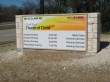
Monument Sign: A low level free standing sign. Normally all evidence of poles are covered or hidden. Off-Premise Sign: Any sign that is not appurtenant to the use of the property, a product sold, or the sale or lease of the property on which it is displayed, and that does not identify the place of business as purveyor of the merchandise, services, etc., advertised upon the sign. Also known as Outdoor Advertising. On-Premise Sign: A communication device whose message and design relates to a business, an event, goods, profession or service being conducted, sold or offered on the same property as there the sign is erected. Opaque: To not allow any light to transmit thru. The opposite of translucent. Open Channel Letter: A dimensional letter that has no face and, if illuminated with the light source visible. A clear face for physical protection of internal components may be used. Painted Wall Sign: See building mounted sign. Pan Channel Letter: A dimensional letter that is constructed with side walls, back and a face making the letter a solid integral unit with the side walls and back having a pan-shaped cross section. Pan Face: A plastic sign face molded into a three dimensional shape. Also called molded face, molded and embossed face, molded and debossed face. Parapet Sign: A sign mounted on top of the parapet of a building. (See building mounted sign.) Permanent Sign: A sign attached to a building, structure, or the ground in a manner that enables the sign to resist environmental loads, such as wind, and precludes ready removal or movement of the sign. Photo-cell: A switch that turns on when dark and off in daylight. Plexiglas: Rohm & Haas brand name for their acrylic plastic sheet. Point-of-Purchase Sign: signs that advertises a product at its point of sale, or "point of purchase" location. Pole or Pylon Cover: An enclosure for concealing and/or for decorating poles or other structural supports of a ground sign. Polycarbonate: The most break resistant and high impact type of plastic, but susceptible to yellowing and dulling with age. Not as rigid as acrylics. POP (Point of Purchase): signs that advertises a product at it's point of purchase. Portable Sign: A sign not permanently attached to the ground or building, with a power-cord for connection to an electrical source, and readily removable using ordinary hand tools. Post and Panel Sign: An unlighted sign fabricated by using one or more visible posts to support the sign body. Projecting Sign: A building mounted sign with the faces of the sign perpendicular to the building fascia. Push-Through: A letter or logo cut out of a backing material that is as thick or thicker than the sign face material, and mounted on the inside of the sign face so that the backing material's thickness extends flush with or through and beyond the front plane of the sign face. Pylon Sign: A freestanding sign with visible support structure or with the support structure enclosed with a pole cover. Raceway: An electrical enclosure that may also serve as a mounting structure for the sign. Readability (Also conspicuity.): The quality that enables the observer to correctly perceive the message. In transportation engineering, this word is being replaced by conspicuity. Recall: In signs, this refers to the ability of a viewer to remember the message even when they are not viewing it. Recognition: Refers to the ability of a viewer to identify the message. Regulatory Sign: A sign having the primary purpose of conveying information concerning rules, ordinances or laws. Retainer: A framing member mounted around the perimeter of a sign face, and attached to the sign cabinet structure. It is designed to attach the face to the cabinet and/or intended to provide a decorating trim piece. Return: The sides of a channel letter. Reveal: An indented detail on a sign. Reverse Channel Letter: A fabricated dimensional letter with opaque face and side walls. Roof Sign: A building mounted sign erected on the roof of a building. Section Modulus: The shear strength for steel poles and I-Beams can be measured in section modulus. Wind loads for signs can be mathematically calculated to show the section modulus needed. Sidewalk/Sandwich Sign: A moveable sign not secured or attached to the ground or surface upon which it is located, but supported by its own frame and most often forming the cross-sectional shape of an A. Sign: Any visual display with words or symbols designed to convey information or attract attention. Sign Band: A horizontal area above a multi-tenants' building's entrances, architecturally designed to accommodate signs. Sign Face: The area of a sign on which copy is intended to be placed. Signs: A system of signs. Signature Building: Architectural design of a building or structure that reinforces signs. Signcentric Design: Building architectural design which makes the signs the prominent visual feature. Single-Face Sign: A sign with only one face plane. Skin: The outer surface of an angle iron steel sign frame, normally a aluminium sheet, formed to fit Stationary Sign: A sign with a power-cord for attachment to a source of electrical power that is not readily moveable or portable. Street Furniture: Advertising displays, many which provide a public amenity, positioned at close proximity to pedestrians for eye-level viewing or at a curbside to reach vehicular traffic. An example is a bench sign. Target Audience: The profile of the most desired consumer prospects for a product or service, listed by characteristics such as demography, lifestyle, brand or media consumption, purchase behavior, etc. This is common to all media. Temporary Sign: Any sign not intended for permanent installation, such as banners and signs at construction sites. They may be incidental or miscellaneous in nature, such as political and real estate signs. Time and Temperature Display: A variable message sign which displays current time and temperature in a stationary or alternating manner. Some also display simple messages. Time, Place and Manner Regulations: Consistently applicable non-discriminatory sign regulations that specify, without reference to the content of the message, when, how and where a sign can be displayed, with physical standards, such as but not limited to height, size and location, that allow the sign to be readable. Tracking: Uniform adjustment of the spaces between multiple letters. (Also see Kerning.)
Trade Area: Most retail businesses have a relatively fixed area that customers come from to do business at their store In general; the trade area is either the living or work locale for the customer. The selling zone of place-based retail business will be dynamic for two reasons; the customer is moving residences or jobs or the customer is passing through on a trip that intersects the trade area. The trade area for most small businesses is 3 to 5 miles. Trademark: Used by a business to distinguish itself and its products from the competition. A trademark may include a name, symbol, word or combination of those. Protected by the federal government and considered to have financial value. The circled "R" or "Reg. T.M." printed with the mark indicates that it is a registered trademark. Traffic Count: The recording of the vehicles and pedestrians passing a given point, usually in a day. Transformer: Electrical equipment that converts input voltage and current to a different output voltage and current. Translucent: To allow light to transmit thru. UL: An abbreviation for Underwriters Laboratories, Inc., a Nationally Recognized Testing Laboratory. UL 48: Underwriters Laboratories approximately 100 page book of sign standards that U.L. listed signs must meet. UL or ETL listed: Underwriters Laboratory, A private Listing company that inspects Electrical Devices and their construction. Many cities require signs to be listed (inspected and approved by UL.). Under-Canopy Sign: A sign designed to be mounted underneath a canopy. USSC: United States Sign Council. UV: Ultraviolet light from the sun. It affects acrylic cast-in colors and causes yellowing of polycarbonate plastics. UV Inhibitors: A material added to SABIC (formally G.E.) Lexan (above), and applied in Solargard and Optigard to reduce the effects of Ultraviolet rays from the sun Vacuum-formed: Plastic is heated until pliable and then placed over a die, vacuum is applied. When cooled the plastic holds the shape of the die. Variable Message Sign: A sign that includes provisions for message changes. Also called changeable copy panel, changeable copy sign, time and temperature sign, electronic message center, menu board. Variance: Special administrative procedure by which one may obtain an exception to zoning rules such as height, setback and type of use. Visibility: The quality of a letter, number, graphic, or symbol, which enables the observer to distinguish it from its surrounds or background. Wall Sign: A building mounted sign. (See also Fascia sign.) Way finding: Enabling a person to find his or her way to a given destination thru the use of effective signs. Window Sign: A sign that is displayed in a window. Wind-load: A term for describing the design strength of a sign. Standard wind load is 30 PSF (pounds pr square foot) in Northeast Texas, which can withstand winds up to 100 MPH. Florida signs are designed for 140 MPH winds.
FOR ORDERING OR ASSISTANCE CALL:214-339-2227 254-582-7446 817-861-1234 903-561-5959 940-365-3433 972-850-3300 877-SINCE79 toll free
Business Hours Signs Manufacturing & Maintenance Corp.
Copyright© 1979-2025 Signs Manufacturing Corporation - ALL RIGHTS RESERVED
| ||||




_medium_110.jpg)