

.jpg)

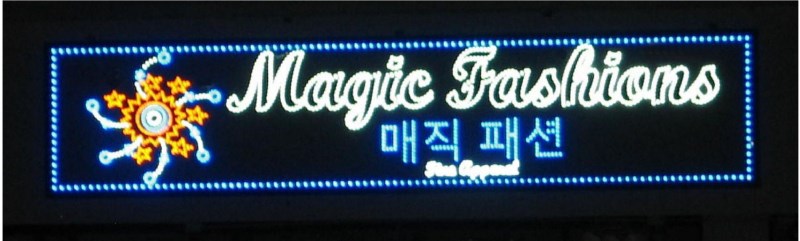
SolarBrite™ PinLights™
External L.E.D. Lighting
for Pole Sign and Pylon Sign Faces
A Brighter Future...Using Less Energy™
 Signs Manufacturing™ incorporates a patent pending high-tech design into our unique
new-look concept.
Signs Manufacturing™ incorporates a patent pending high-tech design into our unique
new-look concept.
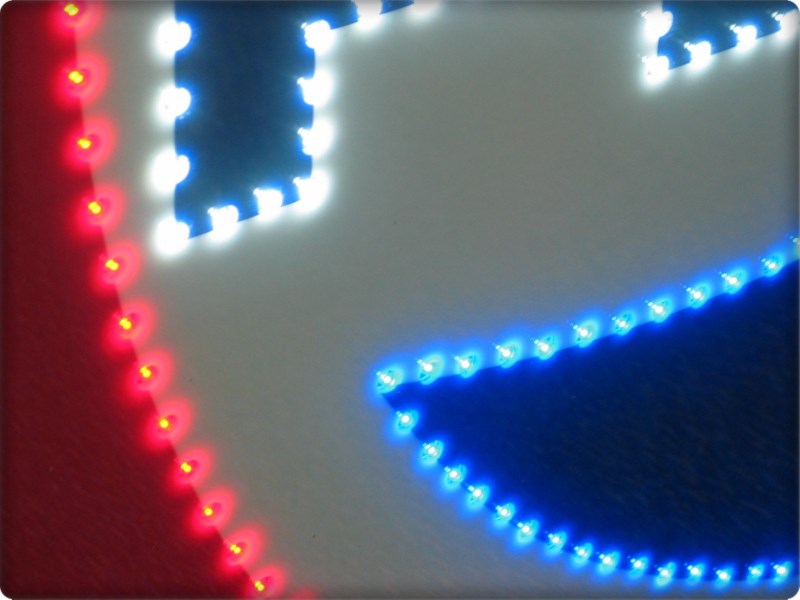
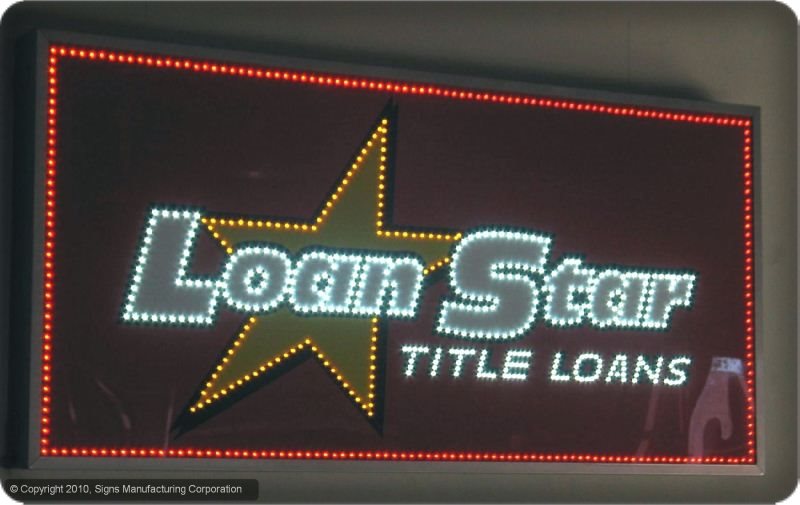
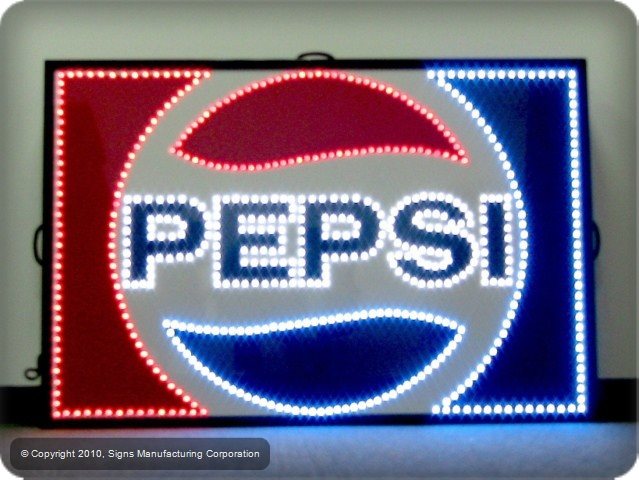
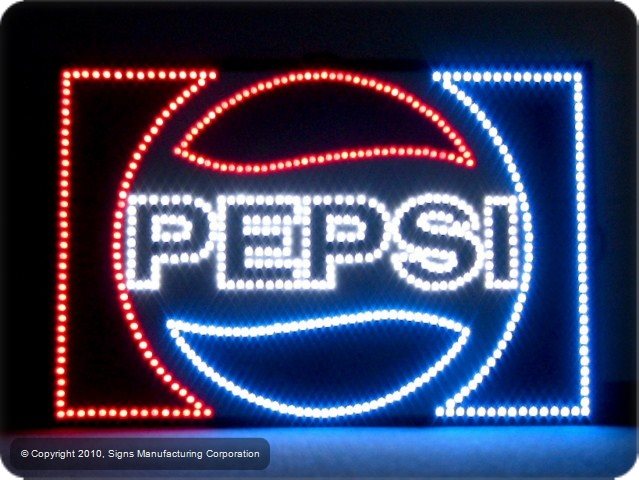
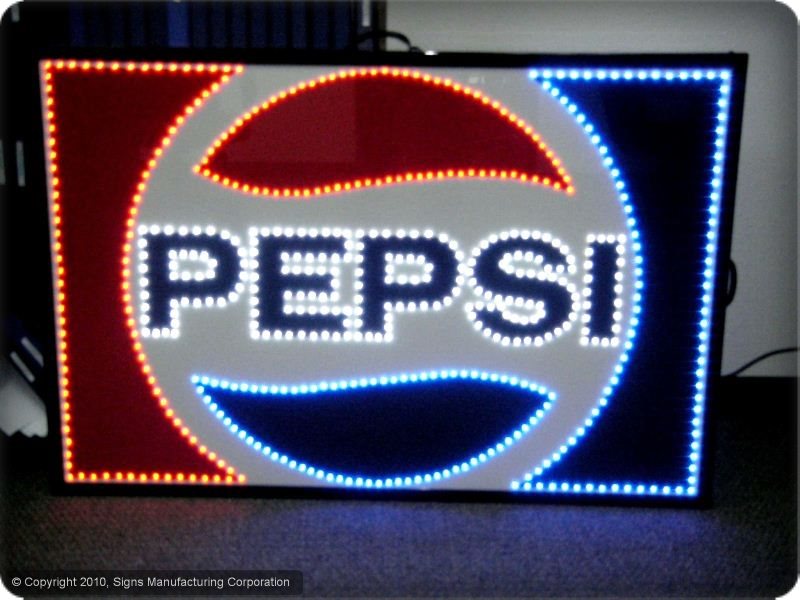
 PinLights™ LED first-surface lighting systems
feature SolarBrite™ LEDs that are optically enhanced to appear larger.
PinLights™ LED first-surface lighting systems
feature SolarBrite™ LEDs that are optically enhanced to appear larger.
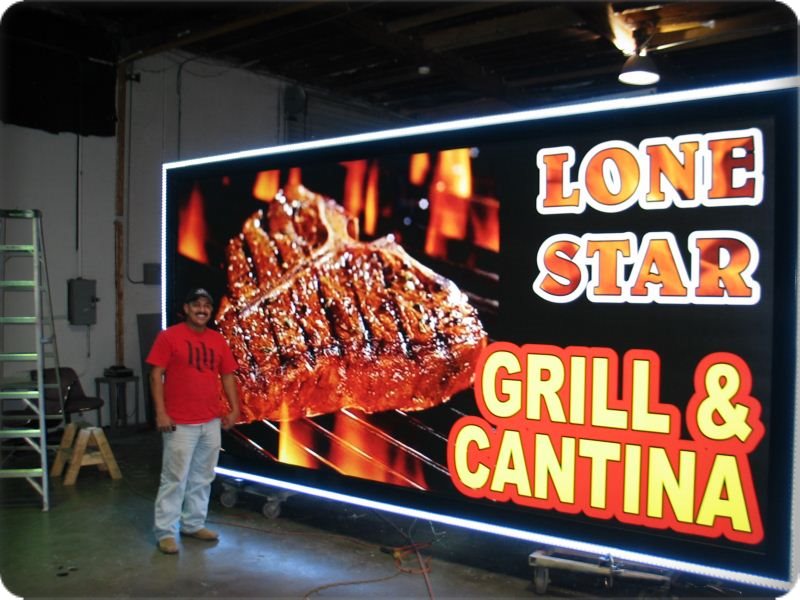
Pole or pylon signs with color graphics and PinLights™ LED first-surface lighting is a hands-down winner.
 No other face-decorated cabinet sign
incorporates direct lighting.
And when compared to incandescent lighting or fluorescent
back-lighted cabinet signs it is better-looking, cheaper, lasts longer, and uses
less energy.
No other face-decorated cabinet sign
incorporates direct lighting.
And when compared to incandescent lighting or fluorescent
back-lighted cabinet signs it is better-looking, cheaper, lasts longer, and uses
less energy.
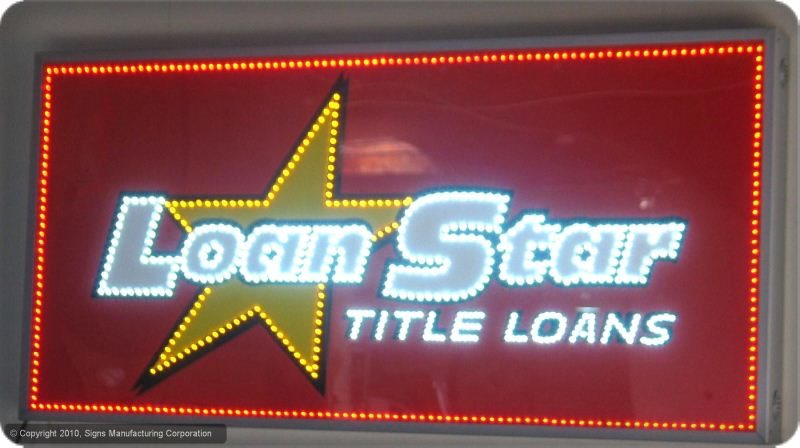
 PinLights™ can even "Twinkle." Importantly, the individual lights never go "off", they DO NOT "flash." Many cities ban flashing lights.
The US Small Business Administration (SBA) says that an electronic message center will increase a store's volume 15 to 150%.
The attribute that makes LED Electronic Message Centers so effective is that they use light to attract attention during the day.
This is the only other sign face that can do so. With LED first-surface lighting, again like electronic message centers, you determine the daytime brightness of your sign by the density, colors, and patterns of lighting you choose. PinLights™ gives you choices, unlike all other forms of lighting.
PinLights™ can also comply with many cities bans on flashing lights, which causes electronic message centers to be banned or severely restricted, or they can flash or twinkle (in multiple or varying colors.)
But at a minimum the decorated sign face is comparable to a traditional back-lighted sign face when not lighted.
In other words, a PinLights™ sign will always look better, and attract more attention, than any cabinet sign ever built previously; and...it can cost about the same to purchase, but use less energy.
 Many companies manufacture
LEDs. There are over 5,000 varied LEDs available,
and they vary greatly as to brightness, lux, light-dispersal
(viewing) angle, useful lifetime, and lifetime.
Many companies manufacture
LEDs. There are over 5,000 varied LEDs available,
and they vary greatly as to brightness, lux, light-dispersal
(viewing) angle, useful lifetime, and lifetime.
Some are very cheap, some are quite expensive.
Signs Manufacturing™ only uses SolarBrite™ LEDs that are rated to retain 80% of their brightness for 60,000+ hours. These are the most expensive, but highest value, conventional LEDs. Our selection of LEDs is what makes our signs brighter, and last longer.
 As an example, a White SolarBrite™ LED is 280 lux, compared to our
BrighterSigns™ neon's 235 lux, or standard neon's 140 lux. "Lux" is the candle-power of light shining on a surface.
As an example, a White SolarBrite™ LED is 280 lux, compared to our
BrighterSigns™ neon's 235 lux, or standard neon's 140 lux. "Lux" is the candle-power of light shining on a surface.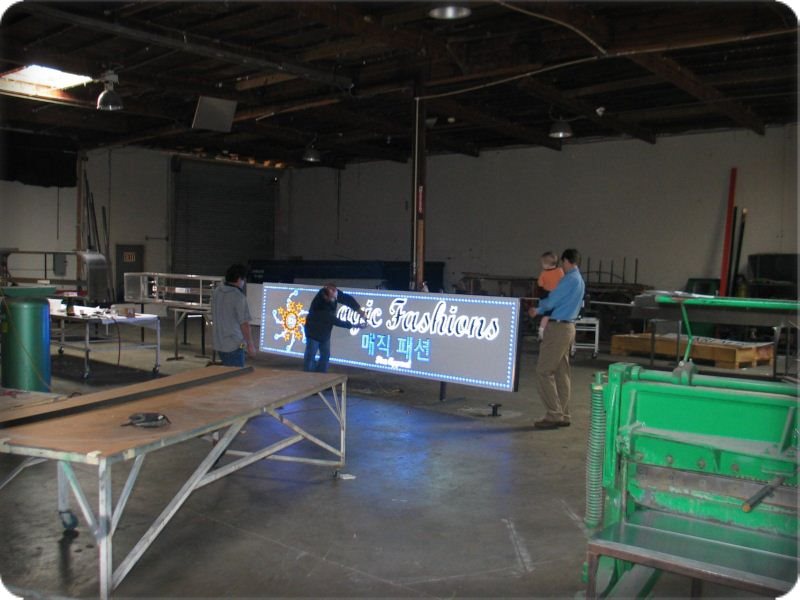
However, with visible light sources "nits" are more important than "lux." As explained below, Signs Manufacturing Corporation's SolarBrite™ LEDs are 8,000 to 13,000 nits, depending on color.
A SolarBrite™ LED incorporates a new kind of chip, different from all other LEDs. Signs Manufacturing™ is an industry leader in the implementation of new technology in advertising.
SolarBrite™ LEDs utilize military specification coatings on the circuit boards the LEDs are attached to, preventing corrosion and electrical problems.
Like neon, LEDs are also affected by
voltage. For instance, an LED will also burn nearly
100% brighter if you double the power feeding it.
The LED will last about 1/6 as long, however, making this
alternative quite expensive in total cost. We power our SolarBrite™ LEDs properly.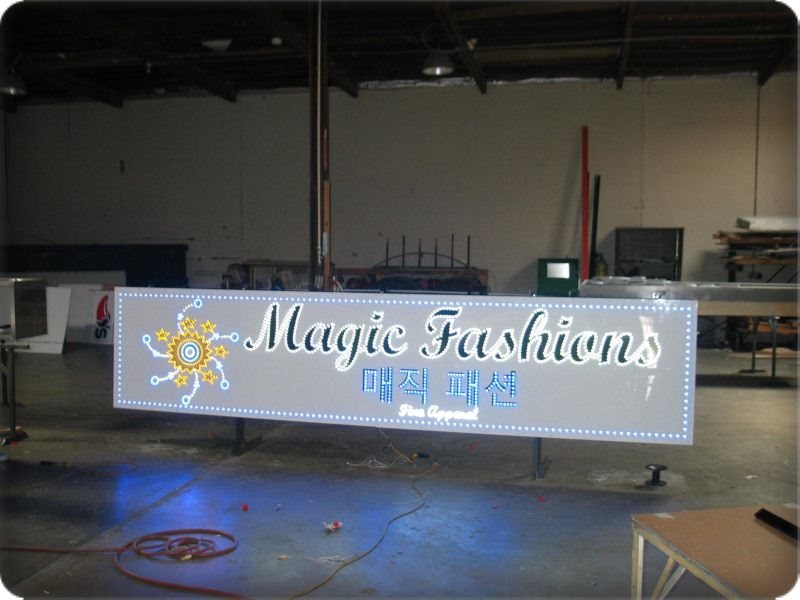
SolarBrite™ PinLights™ LEDs are available in 5 fixed colors (Red, Green, Blue, White and Yellow) or as multi-color infinitely-variable individual lights featuring 65,000,000 colors.
Unlike virtually every other LED sign currently manufactured, each individual PinLights™ LED is independently serviceable.
And if a single LED does fail all of the other LEDs still light. Our wiring is in parallel, not in series.
In most instances PinLights™ LED first-surface lighting systems can be retrofitted to existing internally lighted cabinet signs, pole and pylon signs, and Monument signs.
What is Binning?
ALL LED lamp production is binned, grouped with LEDs with similar properties, 3 different ways: color, flux (brightness), and forward voltage (the minimum voltage the LED will operate at, using a specified minimum operating current.) All 3 vary in even a single wafer’s production, so binning is critical.
LED “binning” is controlled by an ANSI minimum standard: ANSI C78 377A. SolarBrite™ LEDs are binned to much tighter standards, however, which is allowed.
If a competitor BRAGS that their product is binned, they are probably warning you that they will not be able to match color and brightness later, when replacement parts are needed, because their sign’s individual LED color and flux is not adjustable.
The SolarBrite™ LongLife™ LED System
An operating LED is a direct electrical short; it will consume all the current fed to it; destroying both it and its power source. However, an LED has a rather-constant voltage drop when operating. A current-limiting resistor is placed in-line with LEDs to restrict the forward current.
Remember that each LED consumes differing amounts of electricity to operate, which is partially why they were binned (above.) Forward voltage even varies based on the color of light produced by an LED. We obviously must supply enough voltage to meet the highest forward voltage requirement. Therefore each resistor is also sized to consume the potential over-supply of voltage from the power source feeding all the LEDs.
Done properly, this double-protection lengthens the life of LEDs (reduces heat-generation.) This is a critical part of the SolarBrite™ LongLife™ System.
SolarBrite™ LongLife™ LEDs are NOT Chinese-made.
Solar Powered Energy Saving Signs
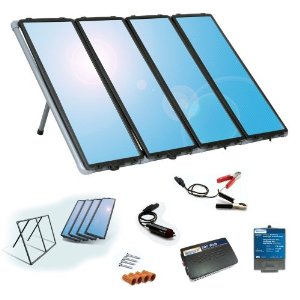 PinLights™ Cabinet signs can be economically directly solar powered, without even using an energy-robbing inverter, saving you even more!
They are the only major business sign that can.
You are saving much more than just energy, and money.
Energy-Saving PinLights™ Signs
PinLights™ consume 0.1 watt per light at 5 volts DC! One thousand lights left on 8 hours per day for 365 days will use $4.01 in electricity.
.jpg)
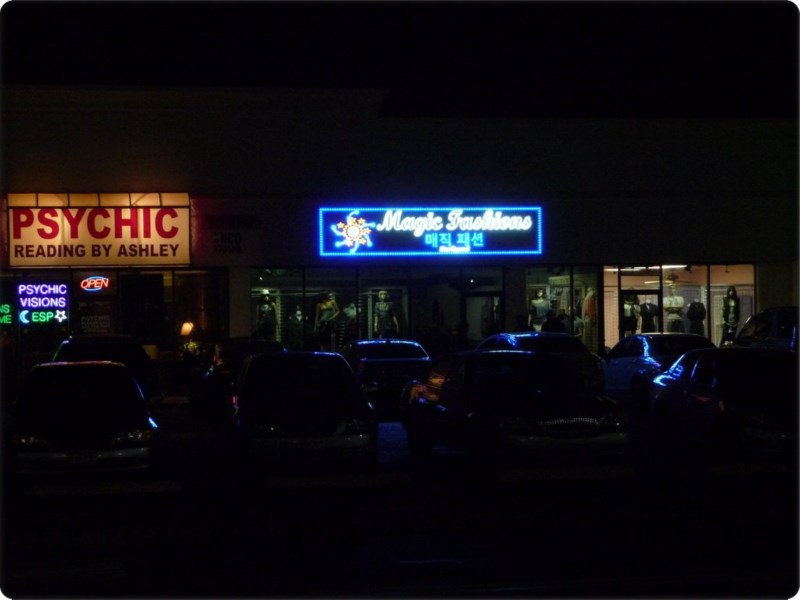
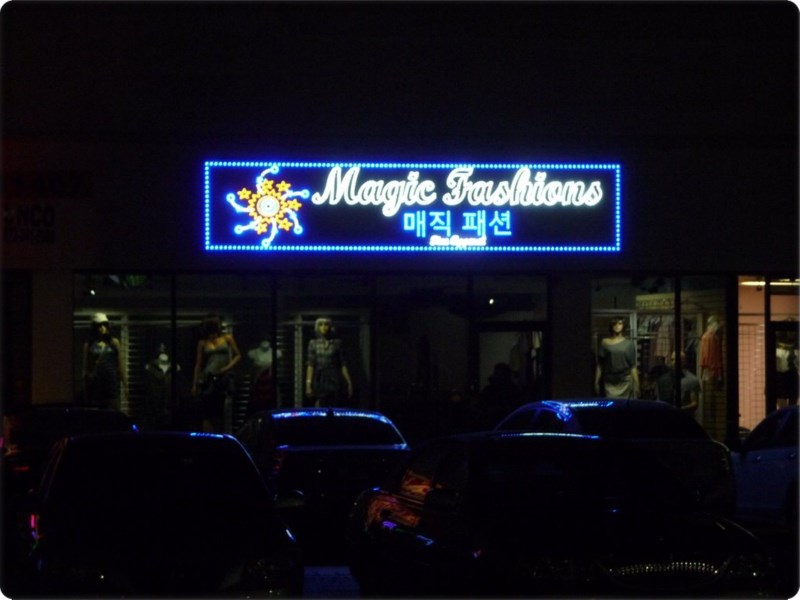
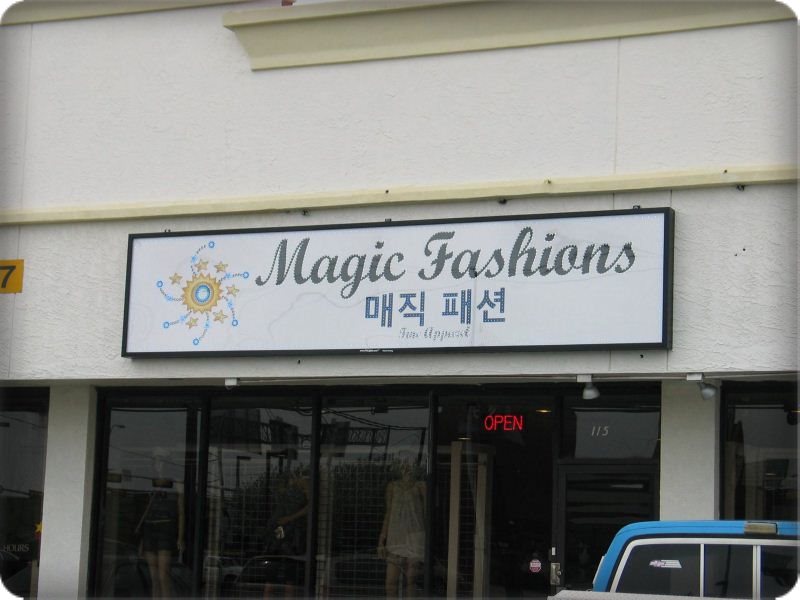
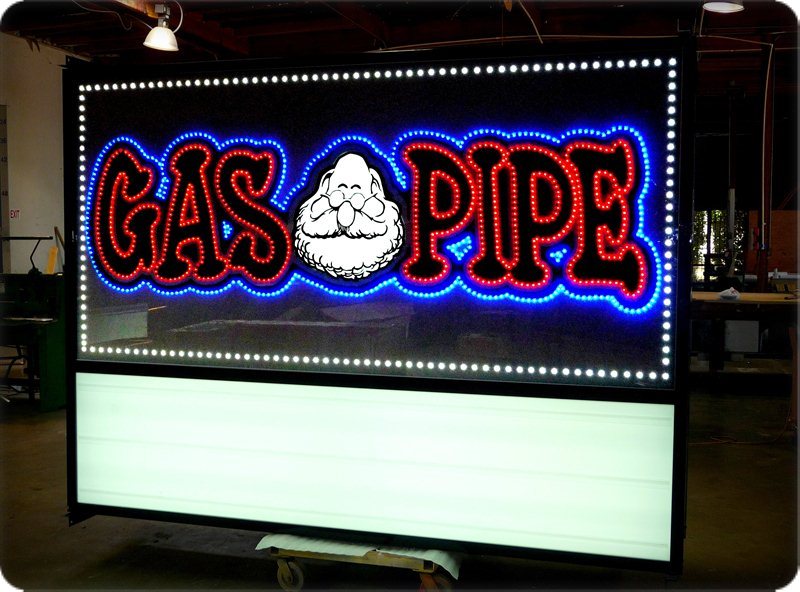
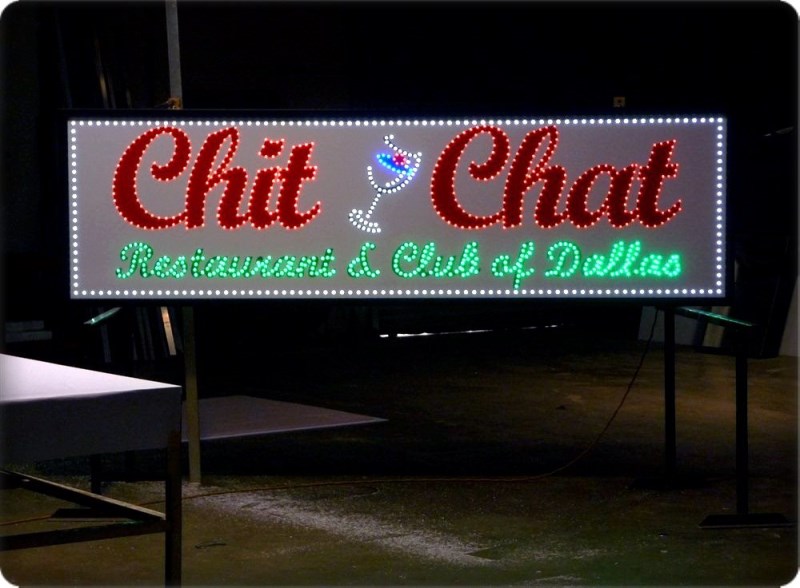
"That's beautiful!"
Emily Wright, Chit Chat Restaurant, upon seeing her new sign in our warehouse before installation.
.jpg)
.jpg)
Click to Enlarge.
Patent Pending
UL or ETL listed Sign Component
Underwriters Laboratories has evaluated PinLights™ and they have been approved for use in outdoor, damp and wet location signs.
UL Approval #E345252.
Ours are the only approved individual LED first-surface lighting products.
As the manufacturer we are very proud of this.
What are LEDs?
A light-emitting diode (LED) is a semiconductor device that emits incoherent monochromatic light when electrically biased in the forward direction. This effect is a form of electroluminescence. The color depends on the semiconducting material used, and can be near-ultraviolet, visible or infrared.
A LED is a special type of semiconductor diode. Like a normal diode, it consists of a chip of semiconducting material impregnated, or doped, with impurities to create a structure called a pn junction. Charge-carriers (electrons and holes) are created by an electric current passing through the junction, and release energy in the form of photons as they recombine. The wavelength of the light, and therefore its color, depends on the band gap energy of the materials forming the pn junction. A normal diode, typically made of silicon or germanium, emits invisible far-infrared light, but the materials used for a LED have band gap energies corresponding to near-infrared, visible or near-ultraviolet light.
Unlike incandescent bulbs, which can operate with either AC or DC, LEDs require a DC supply of the correct polarity. When the voltage across the pn junction is in the correct direction, a significant current flows and the device is said to be forward biased. The voltage across the LED in this case is fixed for a given LED and is proportional to the energy of the emitted photons. If the voltage is of the wrong polarity, the device is said to be reverse biased, very little current flows, and no light is emitted.
Conventional LEDs are made of inorganic minerals such as:
-
aluminium gallium arsenide (AlGaAs) - red and infrared
-
gallium arsenide/phosphate (GaAsP) - red, orange and yellow
-
gallium nitride (GaN) - green
-
gallium phosphate (GaP) - green
-
zinc selenide (ZnSe) - blue
-
indium gallium nitride (InGaN) - blue
-
silicon carbide (SiC) - blue
-
diamond (C) - ultraviolet
LED development began with infrared and red devices, and technological advances have made possible the production of devices with ever shorter wavelengths.
Blue LEDs became available in the late 1990s. They can be added to existing red and green LEDs to produce white light. Most "white" LEDs in production today use a blue LED chip covered by a scintillate coating made of Zinc solenoid (ZnSe). The LED chip emits blue light, part of which is converted to yellow by the ZnSe. This mixture of blue and yellow light creates the impression of white - hence the bluish or yellowish tint that these diodes usually exhibit.
The most recent innovation in LED technology is a device that can emit ultraviolet light. When ultraviolet light illuminates certain materials, these materials will fluoresce or give off visible light. White light LEDs have been produced by building ultraviolet elements inside material that fluoresces to produce white light.
The semiconducting chip is encased in a solid plastic lens, which is much tougher than the glass envelope of a traditional light bulb or tube. The plastic may be colored, but this is only for cosmetic reasons and does not affect the color of the light emitted.
Most typical LEDs are designed to operate with no more than 30-60 millewatts of electrical power. In 2002, 5 watt LEDs became available with efficiencies of 18-22 lumens per watt.
SMD (Surface Mounted Device) LEDs have been created that combine RGB color sources in one LED. They allow the display matrix, pitch, to be much closer. They are very expensive, but more importantly do not have the nits (candela per square meter) for outdoor use.
For outdoor use, you need at least 2,000 nits for daylight use in most situations. (The brightness of LEDs can be turned down.)
Signs Manufacturing Corporation's SolarBrite™ LEDs are 8,000 to 13,000 nits, depending on color.
Please stop by and see all of these products displayed in our unique Sign Lighting Laboratory and Display Showroom.
Literature
We believe we are the only sign company that offers informative literature on signage, our "Sign Buyer's Guide" series.
Our most popular Guides are:
52 Page Brochure

44 Page Brochure

40 Page Brochure

40 Page Brochure

40 Page Brochure

40 Page Brochure

Also Available
Also Available
 |
|
 |
104 Product Videos |